브랜드는 어떻게 성장하나?


How Brands Grow: Part 1—The Double Jeopardy Law Explained
저는 한때 헌츠 토마토와 PAM 쿠킹 스프레이 같은 브랜드에서 근무하던 기업 연구원으로서, 매년 브랜드 계획 시즌이 되면 회의실에 모여 우리 브랜드의 성장이 어디서 나올지를 고민하던 기억이 납니다. 누군가는 침투율을, 또 다른 누군가는 구매율이나 충성도를 주장하기도 했지만, 우리는 종종 브랜드 "전환자"를 타겟으로 삼는 것으로 결론을 내리곤 했습니다. 이 전략들은 우리에게 논리적으로 타당해 보였지만, 실제로는 검증되지 않은 마케팅 속설에 기반한 것이었지, 브랜드 성장이 실제로 어떻게 일어나는지에 대한 과학적 사실에 기반한 것은 아니었습니다.
호주 남부 대학교의 마케팅 과학 교수인 바이런 샤프(Byron Sharp)는 그의 저서 **“How Brands Grow, What Marketers Don’t Know”**을 통해 이러한 추측 전략의 필요성을 바꾸어 놓았습니다. 이 책은 마케터들 사이에서 널리 인기를 끌었지만, 제가 경험한 바로는 대화 상대 중 다수가 이 책을 읽어본 적도 없고 심지어 들어본 적도 없는 경우가 많았습니다. 특히 CPG(소비재) 산업 외부 사람들은 더욱 그렇습니다. 그래서 저는 이 책의 핵심 원칙들을 다음 몇 개의 블로그 포스트를 통해 설명하면 유익할 것이라 생각했습니다. 저는 이 책이 여러분의 브랜드 성장과 마케팅 전략에 대한 생각을 바꿀 것이라고 확신합니다.
toggle
I remember the days as a corporate researcher, working on brands like Hunts tomatoes and PAM cooking spray, where we would sit around a conference table during brand planning season every year, trying to find out where our brand growth would come from. Some would argue for penetration, others for buy-rate or loyalty but often we’d settle on going after brand “switchers” which sounded good to us. While our strategies made logical sense to us, they were often grounded in unproven marketing rules-of-thumb rather than science and facts about how brand growth really occurs.
Byron Sharp, professor of marketing science from the University of South Australia, has changed this need for guesswork-strategy with his seminal work “How Brands Grow, What Marketers Don’t Know.” This book has been widely popular among marketers, but from my experience most of the people I talk to haven’t read it or even heard of it, especially those outside the CPG industry. Because of this, I thought it would be beneficial to lay out some of the key principles of the book over my next few blog posts. I promise you it will change the way you think about brand growth and marketing strategy.
더블 제퍼디 법칙 (The Law of Double Jeopardy)
샤프 교수는 그의 책에서 브랜드 성장과 소비자 구매 습관에 대한 몇 가지 역학을 설명하는 일련의 법칙을 제시합니다. 그는 이 원칙들을 "법칙"이라 부르는데, 이는 그와 그의 동료들의 연구를 통해 이러한 원칙들이 거의 모든 비즈니스 유형(제품 및 서비스, B2B 및 B2C)에서 예외 없이 유효하다는 것이 입증되었기 때문입니다.
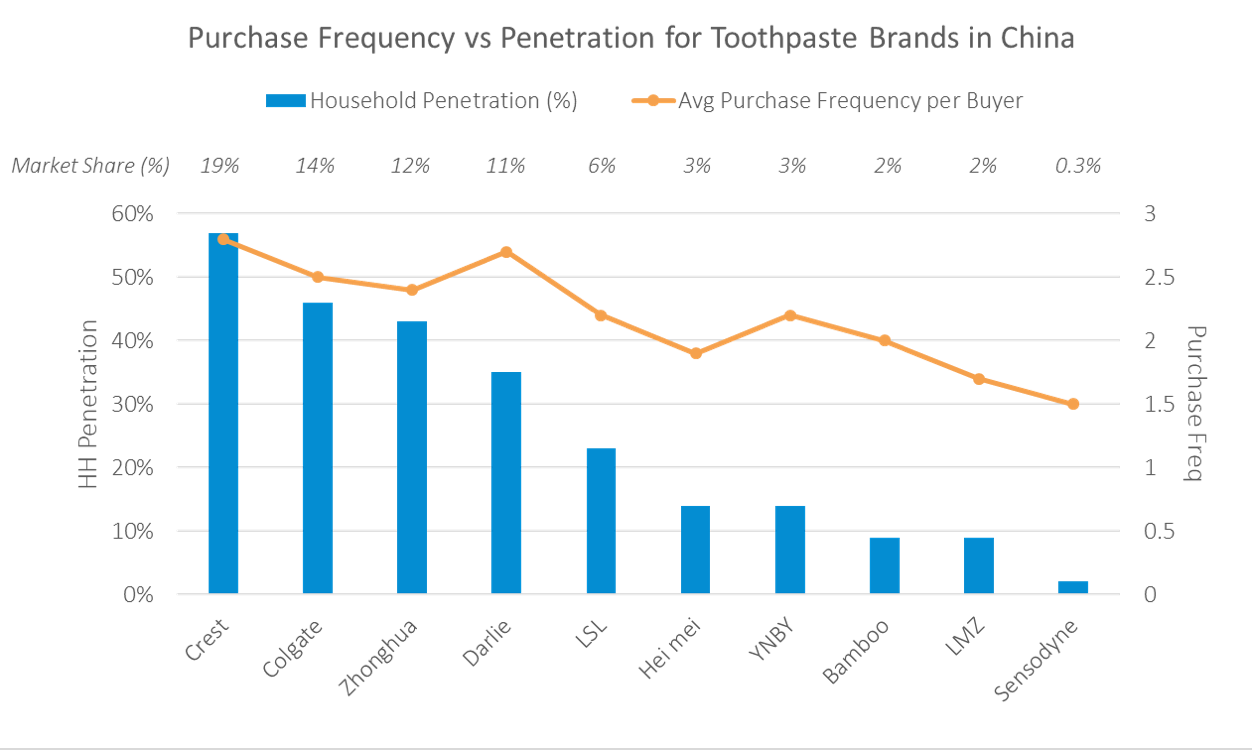
그가 설명하는 가장 중요한 법칙 중 하나는 더블 제퍼디 법칙입니다. 이 법칙은 시장 점유율이 적은 브랜드는 더 적은 구매자 수(첫 번째 불리함)와 이 구매자들의 약간 낮은 브랜드 충성도(두 번째 불리함)를 가지기 때문에 그렇게 된다는 것입니다. 즉, 시장 점유율이 감소함에 따라 침투율과 브랜드 충성도가 함께 떨어진다는 것입니다. 더욱이 침투율은 충성도보다 훨씬 더 빠른 속도로 감소합니다. 아래 차트는 이러한 역학을 보여줍니다. 시장 점유율이 감소할 때, 침투율이 구매 빈도보다 훨씬 더 빠르게 감소하는 것을 확인할 수 있습니다.
toggle
Sharp lays out a series of laws in his book that explain certain dynamics about brand growth and consumer buying habits. He calls these “laws” intentionally, because through his and his colleagues’ research, they’ve proven that these principles hold true in all types of businesses (both products and services, B to B and B to C), and across all countries, with few exceptions.
One of the most important laws he describes is the Law of Double Jeopardy. This law states that brands with less market share have so because they have far fewer buyers (first jeopardy), and these buyers are slightly less brand loyal (second jeopardy). In other words, as market share declines, both penetration and brand loyalty drop together. Furthermore, penetration drops at a much faster rate relative to loyalty. The chart below shows this dynamic. Notice that as market share declines, penetration drops at a much faster rate than purchase frequency.
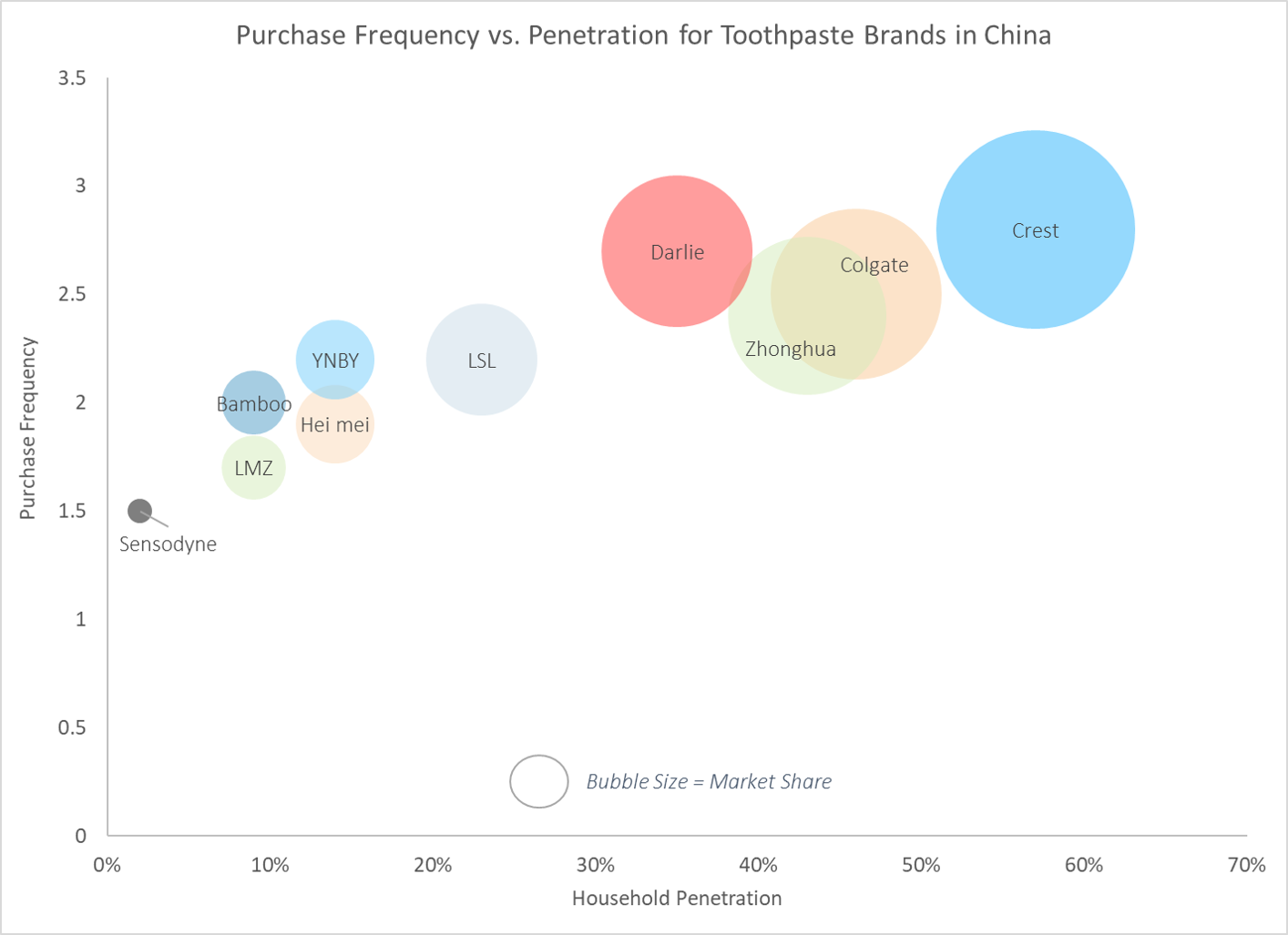
이 동일한 데이터를 다른 방식으로 나타낸 차트에서는 각 버블이 하나의 브랜드를 나타내며, 버블의 크기는 브랜드의 시장 점유율을 나타냅니다. 이 차트에서 y축(구매 빈도/충성도)에는 거의 변화가 없지만 x축(침투율)에서는 큰 변화가 있음을 알 수 있습니다. 샤프 교수와 그의 동료들은 이 관계가 모든 제품 및 서비스 카테고리, 즉 식료품, 산업 브랜드, 서비스, 상점, 신문, 라디오 방송국 등에서 일관되게 나타난다는 것을 보여주었습니다.
이 법칙이 중요한 이유는 브랜드가 성장할 때도, 쇠퇴할 때도 이 법칙이 유효하기 때문입니다. 따라서 브랜드가 성장함에 따라 이 더블 제퍼디 연속선 상에서 이동하게 되며, 이는 브랜드 성장이 어떻게 이루어지는지에 대한 몇 가지 중요한 시사점을 제공합니다.
toggle
Here is the same data shown in a different way, where each bubble is a brand, and the bubble size represents the size of the brand’s market share. Notice how little difference there is in the y-axis (purchase frequency/loyalty) versus the change in penetration in the x-axis. Sharp and his colleagues have shown that this relationship is consistent in all categories of products and services – grocery products, industrial brands, services, stores, newspapers, radio stations, etc.
Why is this important? This law holds true as brands both grow and decline. Thus, as a brand grows, it moves along this double jeopardy continuum, which leads to a several critical implications for how brands grow.
더블 제퍼디의 시사점 (Implications of Double Jeopardy)
아마도 가장 큰 시사점은 브랜드 성장이 주로 침투율에서 비롯된다는 것입니다. 더블 제퍼디 패턴에서 보듯, 브랜드 간 충성도에는 큰 차이가 없으므로, 충성도만을 키우는 것만으로는 의미 있는 성장을 이룰 수 없습니다. 따라서 브랜드 성장 전략은 구매율이나 충성도보다 침투율을 강조해야 합니다.
더블 제퍼디 법칙은 또한 충성도를 향상시키는 것이 약한 성장 동력임을 시사합니다. 실제로 이 법칙은 시장 점유율을 개선하지 않고서는 충성도를 성장시키기 매우 어렵다는 것을 보여줍니다. 즉, 충성도의 증가는 시장 점유율의 향상에서 비롯되며, 그 반대가 아닙니다! 이는 마케팅 전문가로서 우리가 배워왔던 모든 것에 반하는 혁명적인 내용입니다. 즉, 기존 고객에게 한 개의 제품을 더 판매하는 것이 새로운 고객을 찾는 것보다 항상 더 저렴하고 쉽다는 통념을 뒤집는 것입니다. 이는 충성도 구축 전략에 마케팅 비용을 쓰는 것이 대개 마케팅 예산의 낭비일 수 있음을 시사합니다. 이 부분은 다음 블로그 포스트에서 더 깊이 다룰 것입니다.
toggle
Probably the biggest implication is that brand growth comes primarily from penetration. The double jeopardy pattern, with modest changes in loyalty across brands, shows that you can’t have significant growth by growing loyalty alone. Thus, brand growth strategies need to emphasize penetration over buy rate or loyalty.
Double Jeopardy also implies that improving loyalty is a weak growth driver. In fact, the double jeopardy law shows that it is very difficult to grow loyalty without improving market share because they change together. Thus, loyalty gains are a result of improving market share, not the other way around! This is quite revolutionary, as it flies in the face of everything we’ve learned as marketing professionals – that it is always cheaper and easier to sell one more unit to an existing customer than to find a new one. It implies that spending money on loyalty building strategies will typically be a poor investment of marketing dollars. We will go into this in more depth in a later blog post.
더블 제퍼디가 발생하는 이유는 무엇인가? (Why does Double Jeopardy occur?)
더블 제퍼디 법칙은 대부분의 마케터들이 믿는 제품 성능, 포지셔닝, 고객 기반의 극적인 차이에 의해 발생하는 것이 아니라, 샤프 교수가 말하는 **정신적 가용성(mental availability)**과 **물리적 가용성(physical availability)**이라는 두 가지 주요 요소에 의해 발생합니다.
- 정신적 가용성: 구매 상황에서 브랜드를 떠올릴 가능성
- 물리적 가용성: 브랜드를 구매하고 찾기 쉬운 정도
큰 브랜드는 정신적, 물리적 가용성에서 모두 우위에 있습니다. 그들은 더 높은 인지도를 가지고 있으며, 작은 브랜드보다 훨씬 더 많은 곳에서 판매됩니다. 또한, 더 넓은 제품군과 더 많은 진열대를 확보하고 있습니다(소비재의 경우). 이러한 요인들은 침투율과 충성도 모두에 영향을 미칩니다. 소비자들이 구매할 때, 더 많은 유통망을 가진 브랜드를 볼 가능성이 높아지고, 평균 소비자는 들어본 적이 있는 브랜드를 더 고려할 가능성이 큽니다. 따라서 더 큰 브랜드는 더 많은 구매자를 유치할 뿐만 아니라, 구매자들의 고려 목록에 포함될 가능성이 높아져 궁극적으로 충성도도 높아집니다. 큰 브랜드는 또한 라이트 바이어(light buyer)들에게도 유리합니다. 라이트 바이어들은 작은 브랜드를 들어본 적이 없거나 쇼핑할 때 볼 가능성이 적기 때문입니다. 이 모든 역학의 순 효과는 침투율과 충성도가 함께 움직이는 더블 제퍼디 법칙입니다.
샤프 교수는 이 법칙이 시사하는 바는 마케터들이 브랜드를 차별화하려는 노력이나 충성도 프로그램에 시간을 덜 할애하고, 성장의 기초가 되는 정신적 가용성과 물리적 가용성을 구축하는 데 더 많은 시간을 할애해야 한다는 것이라고 주장합니다. 저는 이 점에 동의하지만, 그는 정신적 가용성을 구축하는 데 있어 브랜딩이 얼마나 중요한지 언급하지 않은 부분이 아쉽습니다. 또한 물리적 가용성이 단순히 유통망에만 국한되지 않고, 고객이 제품을 구매하기 쉽도록 만드는 모든 과정을 포함한다는 점도 지적합니다. 이는 잠재 고객이 가질 수 있는 주요 장벽을 해결하고, 다양한 소비자에게 어필할 수 있는 제품군을 마련하며, 가격을 합리적으로 책정하고 구매 과정을 최대한 매끄럽게 만드는 것을 의미합니다.
이 블로그가 샤프 교수의 브랜드 성장 원칙 중 하나를 명확히 이해하는 데 도움이 되길 바랍니다. 다음 두 개의 블로그에서는 충성도 구축 전략의 오류와 침투율을 높이는 데 있어 라이트 바이어의 중요성에 대해 더 깊이 다룰 예정입니다. 의견이나 질문이 있으면 언제든지 댓글을 남겨주세요.
toggle
The Double Jeopardy law is driven not so much by dramatic differences in product performance, positioning, or customer bases, which is what most marketers believe, but rather two key factors that Sharp calls mental and physical availability:
- Mental availability: the propensity for the brand to be thought of in buying situations
- Physical availability: how easy the brand is to buy and find
Large brands are higher in both mental and physical availability. They have stronger awareness and are sold in far more places than smaller brands. Additionally, they have wider assortments and more facings on shelf (for consumer products). These implications impact both penetration and loyalty. As consumers go to buy, they are more likely to see brands that have greater distribution, and the average consumer is more likely to consider brands they’ve heard of. Thus the larger brands will not only attract more buyers, but they will increase their chances of making it into the consideration set of the buyers which ultimately increases loyalty because they have greater physical availability. Large brands also have an advantage with light buyers because light buyers are less likely to have heard of the smaller brands and are less likely to see them when shopping. The net effect of these dynamics is the double jeopardy law, where both penetration and loyalty move in the same direction.
Sharp maintains that the implications of this law are that marketers should be spending less time and money trying to differentiate the brand and on loyalty programs, and more time trying to build mental and physical availability which are the foundation for growth. I agree but I think he leaves out how necessary good branding is for building mental availability, and that a poor brand strategy makes it an uphill battle. Additionally, he points out that physical availability doesn’t just mean distribution, it also equates to making your products as easy as possible to buy. This means addressing key barriers that your potential customers could have, having varieties that appeal to a broad audience or your target, making the price reasonable even if it means downsizing, and making the buying process as seamless as possible.
I hope this blog helps clarify one of Sharp’s building blocks for brand growth. In the next two blogs, I will expand on these principles and discuss in more depth the fallacy of loyalty building strategies and the importance of light buyers to growing penetration. If you have any comments or questions, feel free to chime in below.
브랜드 성장의 법칙: Part 2 —왜 라이트 바이어가 중요한가 (Why Light Buyers are Key - Peel Research Services)
까다로운 라이트 바이어들... 정말 그들이 필요할까요? 그들은 브랜드에 거의 관심이 없고, 카테고리에 대한 관심도 적으며, 충성심 없이 무심하게 구매합니다. 게다가, 헤비 바이어들에게 한 개의 제품을 더 판매하는 것이 훨씬 쉽고 저렴하지 않을까요?
라이트 바이어에 대해 이렇게 생각하는 것은 완전히 자연스럽고 논리적으로도 타당해 보입니다. 그러나 이렇게 생각하면 브랜드 성장의 주요 원천을 간과하게 될 수 있습니다. 이번 포스트에서는 “How Brands Grow” 마케팅 과학 시리즈(샤프와 로마니우크 저, 옥스퍼드 출판, 2010 & 2016)의 연구 결과를 바탕으로, 헤비 바이어를 타겟으로 한 성장이 헛된 노력임을 설명하고, 라이트 바이어와 비브랜드 바이어들이 실제로 성장을 이끄는 핵심임을 밝혀보겠습니다.
toggle
Those pesky light brand buyers….who needs them? They hardly care about your brand, are disengaged with the category, and make carefree purchases with little loyalty. Plus, it’s much easier and cheaper to sell one more unit to your heavy buyers, right?
If you feel this way about light buyers, which is completely natural and seemingly logical, you may be overlooking the primary source of brand growth. In this post, drawing on findings from the “How Brands Grow” marketing science book series (Sharp and Romaniuk, Oxford Press, 2010 & 2016), I’ll explain why targeting heavy brand buyers for growth is a fruitless effort, and that it’s actually light and non-brand buyers that are the key to growth.
헤비 바이어는 너무 적다 (Heavy Buyers are Too Few)
누구나 80/20 파레토 법칙을 들어봤지만, 매출과 관련해서는 샤프의 연구에 따르면, 1년간의 분석 기간 동안 상위 20%의 고객이 보통 매출의 50%만 차지하고, 80%까지 차지하지는 않습니다. 따라서 헤비 바이어가 생각보다 그리 중요하지 않을 수 있습니다. 또한, 하위 80%의 고객이 생각보다 크며, 이들은 매출의 절반을 차지합니다. 대부분의 마케터는 자신들의 바이어가 얼마나 라이트한지 알게 되면 놀라곤 합니다. 예를 들어, 영국에서 코카콜라 구매자의 50%는 1년에 1~2캔 혹은 병만 구매하고, 대다수는 1년에 3개 이하의 코카콜라를 구매합니다(TNS 임펄스 패널 출처). 브랜드의 평균 구매량은 1년에 12개이지만, 이는 극소수의 초헤비 음료 소비자에 의해 확대된 것입니다.
헤비 바이어를 통해 성장을 이루려는 것은 이들의 적은 수를 고려할 때 수학적으로 어려운 일입니다. 만약 헤비 바이어를 전체 고객의 20%로 정의하고, 이들이 매출의 50%를 차지한다고 가정할 때, 이들의 구매를 10% 증가시킬 수 있다면, 전체적으로 5%의 성장에 불과합니다. 이는 통조림 식품에는 나쁘지 않을 수 있지만, 대부분의 목표에는 부족합니다.
toggle
Everyone has heard of the 80/20 Pareto curve but when it comes to sales, Sharp’s research shows that in a one year analysis period, your top 20% of customers typically account for only 50% of sales, not 80%. Thus, your heavy buyers aren’t as important as you might think. Additionally, your bottom 80% of customers are bigger than you think, accounting for half your volume. Most marketers are surprised to find out how light their buyers are. As an example, 50% of Coke buyers in the UK buy only 1 or 2 cans or bottles of Coke per year while the majority of buyers purchase 3 or less units per year (Source: TNS Impulse Panel). The brand’s average is 12 per year, but that is magnified by an exceedingly small percentage of ultra-heavy drinkers.
Trying to generate growth from the heavy buyers is mathematically difficult considering their small numbers. If you define your heavy buyers as 20% of your customers, who are responsible for 50% of sales, and you’re able to increase their purchases of your brand by 10%, this equates to only 5% overall growth. Not bad for canned goods, but falls short for most of our ambitions.
헤비 바이어는 더 많이 구매하려 하지 않는다 (Heavy Buyers are Reluctant to Buy More)
헤비 바이어의 구매를 늘리는 것이 쉬워 보이지만, 연구 결과는 그렇지 않다는 것을 보여줍니다. 첫째, 헤비 바이어들은 이미 카테고리 전체에 크게 전념하고 있어 더 많이 구매할 가능성이 낮습니다. 둘째, 이들은 이미 브랜드에 충성하고 있어, 더 많은 구매를 할 여지가 거의 없습니다.
경쟁 브랜드에 충성하는 헤비 카테고리 바이어들을 타겟으로 삼는 것은 어떨까요? 이는 합리적으로 들리지만, 연구에 따르면 이 또한 신뢰할 수 있는 성장 전략이 아닙니다. 이 그룹 역시 헤비 바이어들과 마찬가지로 소수일 뿐만 아니라, 이미 다른 브랜드에 충성하고 있어 이들을 전환시키기 위해서는 상당한 행동 변화가 필요합니다.
toggle
It sounds like it would be easy to increase purchasing of your heavy brand buyers, but the research shows this is not the case. First of all, your heavy brand buyers are likely to be heavy category buyers, which are already heavily committed to the category and unlikely to buy more of it. Secondly, they are already loyal to your brand so there is little room for them to allocate more of their purchases to it.
How about targeting heavy category buyers that are loyal to your competing brands? This sounds reasonable, but the research shows that this is not a reliable growth strategy. Not only is this group small, like your heavy brand buyers, but they also are already loyal to other brands so to get them to switch requires a significant change in their behavior.
브랜드는 라이트 바이어를 크게 증가시키지 않고서는 성장할 수 없다 (Brands Can’t Grow without Significantly Increasing Light Buyers)
샤프와 로마니우크는 세계 각지의 다양한 제품 및 서비스 카테고리에서 수천 개의 브랜드를 연구하여 브랜드 성장이 어떻게 이루어지는지 이해하려고 했습니다. 그들의 연구에 따르면, 브랜드가 성장할 때, 한 번만 구매하는 고객의 수가 크게 증가하고, 여러 번 구매하는 고객 수는 소폭 증가하는 것이 전형적입니다. 따라서 브랜드 성장은 많은 추가적인 라이트 바이어를 확보하는 데 크게 의존합니다.
아래는 그 좋은 예로, 중국의 한 치약 브랜드가 1년 동안 1.5% 성장한 사례입니다. 이때 가장 큰 변화는 브랜드를 한 번만 구매한 사람들 사이에서 일어났습니다. 이 일회성 구매자들이 전체 성장의 65%를 차지했습니다.
샤프와 로마니우크는 이 효과가 모든 종류의 비즈니스에서 반복 가능하고 예측 가능하다는 것을 보여줍니다. 간단히 말해서, 라이트 바이어는 매우 많고, 이들의 구매를 늘릴 여지가 많기 때문에 브랜드 성장의 주요 원천이 되는 것입니다.
이 효과는 제가 이전 포스트에서 요약한 더블 제퍼디 법칙을 설명하는 데에도 중요한 역할을 합니다. 이 법칙은 시장 점유율이 작은 브랜드는 더 적은 구매자를 가지고 있으며, 이 구매자들은 약간 덜 충성적이라는 것을 의미합니다. 대형 브랜드와 소형 브랜드 간 침투율의 극적인 차이는 주로 라이트 바이어에 의해 발생합니다.
toggle
Sharp and Romaniuk have studied thousands of brands across different product and service categories and regions of the world to help understand how brands grow. Their research shows that when a brand grows, there is a big increase one-time purchasers and only a small increase in the number of customers that buy it multiple times. Thus, the growth of the brand is heavily dependent on gaining many additional light buyers.
Below is a perfect example, which shows a toothpaste brand in China that grew 1.5 percentage points from year to year. Notice that the biggest change happened among those buying the brand only once. These one-time buyers accounted for 65% of the total growth for this brand.
Sharp and Romaniuk show that this effect is repeatable and predictable across businesses of all kinds. In a nutshell, the reason why this happens is that light buyers are so numerous and have so much more room to grow their purchasing, so they become a primary source of growth.
This effect is also key in explaining the “double jeopardy” law, which I summarized in an earlier post. This law states that brands with less market share are smaller because they have far fewer buyers and these buyers are slightly less loyal. The dramatic difference in penetration between the large and small brands is driven primarily by light buyers.
마케터와 시장 조사자들에게 주는 시사점 (Implications to Marketers and Market Researchers)
성장을 이루기 위해 마케터들은 브랜드의 라이트 바이어 및 비구매자들을 포함한 고객층을 확장하는 데 집중해야 합니다. 또한, 널리 도달할 수 있는 저비용 미디어를 사용하여 간단한 메시지를 전달하고, 빈도보다는 도달을 강조하며, 구매율보다는 침투율에 중점을 둔 전략을 사용해야 합니다. 이것이 헤비 바이어를 무시해야 한다는 의미는 아니지만, 라이트 바이어를 대상으로 한 마케팅은 결국 브랜드와 카테고리에 강한 참여도를 가진 헤비 바이어에게도 도달할 것이라는 점을 염두에 두어야 합니다.
시장 조사자들은 연구가 헤비 바이어에만 집중되지 않도록 해야 합니다. 이는 흔히 발생하는 실수입니다. 마케터들은 종종 연구에서 라이트 바이어를 포함하는 것을 꺼려하므로, 이에 대한 반발에 대비해야 합니다. 또한, 분석에서 라이트/미디엄 바이어와 헤비 바이어 간의 조사를 포함하십시오. 라이트 바이어가 누구인지, 그들의 필요가 무엇인지, 그리고 그들의 구매 결정을 이끄는 요인이 무엇인지에 대한 차이를 찾아보십시오.
toggle
To achieve growth, marketers should seek to expand their customer base by opening their marketing strategies to include light and non-buyers of their brands. In addition, marketers should use simpler messages with broad-reach, low-cost media that emphasizes reach over frequency and focuses on penetration over buy-rate. Keep in mind that this does not mean you have to ignore your heavy buyers, but be aware that marketing targeted toward light buyers will inevitably also reach heavy buyers due to their strong engagement with your brand and the category.
Market researchers need to ensure that their studies are not solely focused on heavy buyers, which is a common practice. Marketers are often reluctant to include light buyers in their studies so be ready for some push-back. In addition, include a light/medium vs. heavy buyers investigation in your analysis. Look for differences that could help you learn more about the light buyers – who they are, what their needs are, and what drives their purchase decisions.